Noli
 Savona · Liguria
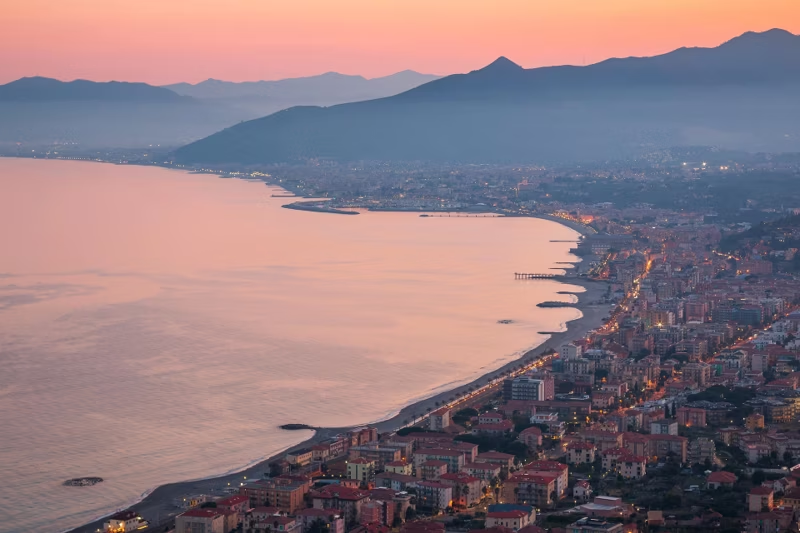
 Noli is the smallest and, by most measures, the most beautiful town on our stretch of coast. It spent four centuries as an independent maritime republic, allied to Genoa, and the evidence is still standing: defensive towers rising straight out of the residential streets, a ruined castle on the hill above, and the Romanesque church of San Paragorio just outside the walls. It is a certified member of I Borghi più belli d'Italia, and the beach below it holds a Blue Flag. What that produces is a market defined almost entirely by scarcity. The historic core is tightly protected, very little can be altered, and the number of properties that can legally and practically be let is small and does not grow. For an owner, that is mostly good news — but it comes with genuine constraints on what you can do to a building here.
 The market
 Scarcity does most of the pricing work. There is no volume of comparable listings to be undercut by, and guests who have decided on Noli have usually decided on Noli specifically rather than shopping the coast. That supports strong rates in season and unusually high booking lead times. The flip side is that a property here cannot be improved out of its limitations: if the building is protected, the windows, the shutters and often the internal layout are what they are, and the listing has to be honest about stairs, room sizes and the absence of a lift.
A concentrated summer, running from June to mid-September with very little either side, softened by a steady weekend trade in spring and early autumn from visitors doing the Borghi più belli circuit and walkers on the coastal path towards Varigotti. Winter is genuinely quiet, and owners here should plan around that rather than hope against it.
Skews older and more culturally motivated than the beach towns nearby — couples rather than large family groups, Italians on short heritage trips, and a meaningful number of northern European visitors who found the town through the Borghi più belli listing. They stay shorter, spend more per night, and care about character over amenities.
Small apartments in medieval and early-modern buildings inside the walls, plus a narrow band of newer property along the seafront road. Expect thick stone walls, irregular room shapes, steep and narrow staircases, and almost no private parking anywhere in the old town. Restoration is constrained by heritage protection, so what exists is largely what there will be.
As everywhere in Liguria, a short let in Noli needs a CIN on every listing, registration with Regione Liguria before the first arrival, and guest details submitted to the Questura through Alloggiati Web within 24 hours. The Comune di Noli sets its own tourist tax. The additional layer here is heritage: if your property sits within the protected historic centre, alterations that would be routine elsewhere may require authorisation, and that is worth establishing before you plan any work rather than after.
Noli is close enough to our base that we can cover it properly, which matters more here than in most places because almost nothing can be delivered to the door. Vehicle access into the old town is restricted and the streets are narrow, so linen, supplies and maintenance all arrive on foot for the last stretch. We plan changeovers here on the assumption that everything is carried, and we would rather tell you that plainly than discover it on a Saturday in August.
What management covers FAQ
FAQ Harder to service, easier to book. Demand for the old town is strong and steady because there is very little of it. The difficulty is operational — restricted vehicle access, stairs, and heritage rules that limit what you can change. Neither is a reason not to let, but both should shape the listing and the price.
Sometimes, and rarely as freely as owners expect. Work affecting the exterior, the structure or original features in the protected centre typically needs authorisation, and the answer varies building by building. Establish what is permitted before budgeting a renovation — we have seen plans collapse at that stage more than once.
Yes, in a modest way. The Borghi più belli listing and the coastal walking route bring weekend visitors through spring and early autumn. It will not replace the summer, but it fills weekends that would otherwise be empty, particularly for smaller properties suited to couples.
Very little, and none of it inside the walls. This is the single most common source of arrival friction in Noli. Set the expectation explicitly in the listing, give precise directions to where guests can actually leave a car, and the problem largely disappears.
Let's talk about your property. Get in touch today, and we'll get back to you within 24 hours.