Albenga
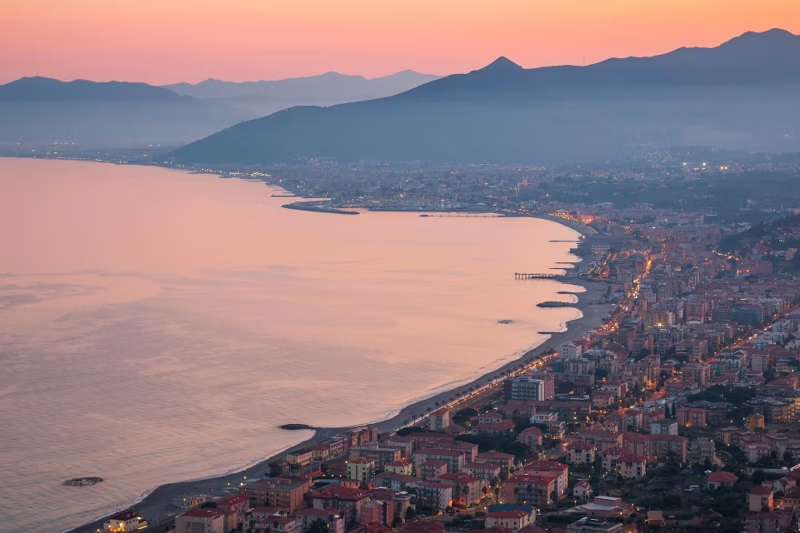
 Savona · Liguria
 Albenga is the least resort-like town on this coast and the most historically substantial. It was Albingaunum under Rome, and the centre still carries that: a medieval quarter of tall brick tower-houses that earned it the name città delle cento torri, an early Christian baptistery that is among the most important late-antique buildings in northern Italy, and a cathedral square that feels like a small inland city rather than a seaside town. The beach is there, a couple of kilometres from the centre, but it is not the point. Albenga is also the agricultural capital of the plain behind it, growing the violet asparagus and the ox-heart tomatoes the region is known for. For owners this means something specific: the town has real year-round life, and a guest who comes here is usually choosing history, food or convenience over the sand.
 The market
 Because the town works independently of the beach, the letting pattern is steadier and less peaked than anywhere nearby except Savona. Guests come for the medieval centre, for the food, as a base for exploring the western Riviera by car, and increasingly for the cycling on the plain and in the hills behind. The centro storico is the strongest asset by a distance: a restored apartment inside the towers has genuine scarcity value and is marketed on character rather than proximity to a lido. Property out towards the beach at Vadino competes on more conventional terms.
A flatter curve than the resort comunes. Summer peaks, of course, but spring and autumn hold up strongly on cultural visitors, cyclists and food travellers, and the town does not shut down in winter the way Laigueglia or Noli does. The agricultural calendar and the markets give the centre a rhythm that runs all year, which guests notice and reviews reflect.
More varied and more international than the neighbouring beach towns. Cultural travellers doing the Roman and medieval sites, food-led visitors, cyclists, and families using Albenga as a cheaper base than Alassio while still driving to the beach. Italian domestic demand remains the largest single share, but the mix here is genuinely broad.
Two quite separate markets. The historic centre offers apartments in medieval and early-modern buildings, often characterful, usually without lifts and with restricted vehicle access. Out towards the sea and the Vadino district the stock is modern and conventional, with parking and easier access but far less distinctiveness. The centre is the harder property to service and the easier one to differentiate.
The Ligurian framework applies — CIN on every listing, Regione Liguria registration before the first guest, Alloggiati Web filings to the Questura within 24 hours — together with the Comune di Albenga's tourist tax. The additional consideration is heritage: much of the historic centre is protected, and alterations affecting the exterior or original fabric of a tower-house are unlikely to be as straightforward as an equivalent job in a 1970s block near the beach.
Albenga is where our western run reaches a proper town again, and it is easy to work in apart from the centre itself, where vehicle access is limited and the last stretch is on foot. We treat centro storico properties and the beach-side stock as separate rounds rather than one route. The town's year-round life helps: unlike the small resorts, there are tradesmen, suppliers and open shops here in January, which makes off-season problems far quicker to solve.
What management covers FAQ
FAQ Yes, and the historic centre is the better product for most of the year. Guests choosing Albenga are usually choosing the towers, the food and the location as a base, not a lido. Trying to compete with Alassio on beach proximity is the wrong fight; the centre wins on character.
More demanding than a modern flat, yes — restricted vehicle access, stairs, and heritage constraints on what can be altered. None of it is prohibitive, but it should shape both your renovation budget and the listing's honesty about access.
Better than any comparable beach town on this stretch. The centre functions all year, the markets and restaurants stay open, and cultural and food travellers keep coming. Rates are modest but occupancy does not collapse the way it does a few kilometres away.
A wider mix than most of the coast: people here for the Roman and medieval sites, food travellers, cyclists working the plain and the hills, and families using the town as a more affordable base for the western Riviera. That variety is what keeps the calendar filled outside August.
Let's talk about your property. Get in touch today, and we'll get back to you within 24 hours.