
Self-managing: when it actually works

Let’s start with something that often gets glossed over: managing a short-term rental yourself is absolutely possible. Thousands of owners do it successfully, and it would be wrong to paint self-management as something doomed to fail.
Self-managing works well when:
- You live close to the property - ideally in the same town or city - and can be on hand quickly if something goes wrong.
- You have enough free time to respond to guest messages, often within minutes, seven days a week.
- You can reliably coordinate cleaning and linen changes between stays, including at peak weekend times.
- You’re already comfortable with booking platforms and you’re not put off by the administrative and regulatory side of things.
- You’re managing one property - two at most - and the whole thing isn’t at risk of becoming a second full-time job.
If that sounds like you, self-management can work well. You’ll have direct control over everything, you’ll build a more personal relationship with your guests, and you’ll save the agency commission. Those aren’t small things.
But there’s another side to this - and it’s worth looking at it honestly.
The reality of self-managing: what almost everyone underestimates
People new to short-term rentals often picture it like this: list the property, bookings come in, money arrives. The reality is a bit different.
How much time it actually takes

A single booking generates dozens of interactions: the initial enquiry, the confirmation, pre-arrival questions, check-in instructions, messages during the stay, the final review. Multiply that across every booking, add in cleaning coordination, fixing things that break, and the middle-of-the-night emergencies that guests always manage to have at the worst possible time - and you quickly realise that running a short-term rental takes significantly more time than it looks from the outside.
Many owners who start out managing alone find themselves, a few months in, unable to enjoy what they’re earning because they’re permanently attached to their phone. That’s not a failure - it’s simply the reality of a job that demands constant availability and responsiveness.
Pricing: the most expensive mistake
This is where most self-managing owners leave money on the table - sometimes a lot of it - without realising.
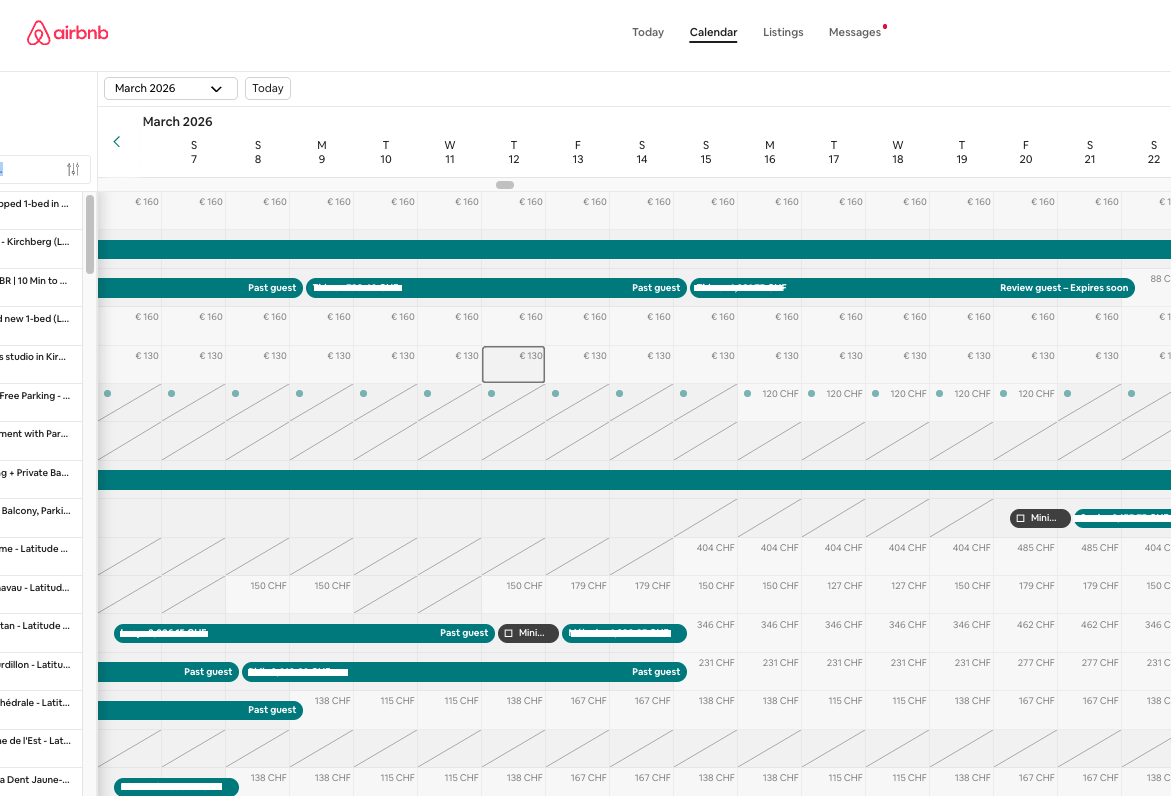
Setting a fixed nightly rate - perhaps based on what nearby properties were charging at some random point in time - is an approach that works poorly in a seasonal market like the Ligurian Riviera. Demand shifts every single week: a July weekend is worth more than a September one, a week that coincides with a local event is worth more than a quiet midweek in May. A property near the port during a major cruise stopover is worth more than one on a slow Tuesday.
Professional managers use dynamic pricing tools that monitor competing listings, search demand, local events, and seasonal trends in real time - adjusting rates multiple times a day if needed. The average uplift on a well-positioned property, compared to a static rate, can easily exceed 20-30% in annual revenue. In many cases, the agency fee pays for itself on this alone.
Reviews: public, permanent, and decisive
Reviews on Airbnb and Booking.com are not just opinions - they’re your public professional record, visible to every potential guest who looks at your listing. And once they’re up, they stay.
The problem with self-management isn’t that owners are careless - most are actually very attentive. The problem is that it only takes one moment of distraction to damage a guest’s experience. A slow response to an urgent message. A boiler problem sorted in 48 hours rather than four. Check-in instructions that aren’t clear enough, leaving a guest stuck outside at eleven at night. Small things that, in another era, would have left no trace. Today they become two-star reviews with a detailed description that anyone can read.
But there’s another dimension to reviews that almost every self-managing owner neglects: responding to reviews, and leaving a review for the guest.
Responding to every review - not just the negative ones - is one of the simplest and most effective things you can do for your listing. When a future guest is looking at your profile, they’re not just counting stars - they’re reading how you respond. A professional, warm, timely reply to a criticism signals confidence and care. Silence, or worse a defensive response, signals the opposite. On Airbnb in particular, profiles with thoughtful responses to all reviews consistently show higher conversion rates.
Leaving a review for your guests after each stay matters just as much. On Airbnb, reviews work both ways and are only published once both parties have written theirs - or after 14 days. Hosts who review their guests first encourage guests to do the same. Owners who do this consistently receive significantly more reviews in return - and more reviews means better visibility, more trust, and more bookings. It’s a virtuous cycle that costs nothing but requires consistency. And consistency is exactly what tends to slip when you’re managing everything on your own.
Professional managers have systems in place for all of this: tested response templates, automated review reminders, clear check-in protocols, and guaranteed availability. It’s not perfectionism - it’s protecting the value of your asset.
A negative review with no response is the worst business card you can leave online. A professional, respectful reply, on the other hand, can turn even a criticism into a demonstration of how well you handle things.
Optimising your Airbnb listing: much more than a few photos and a description

This is one of the most underestimated aspects of short-term rental management. Many owners assume the job is to upload some photos, write a description, and wait for bookings to arrive. In reality, the Airbnb algorithm - and Booking.com’s works in a similar way - is highly specific about what it rewards and what it penalises. Understanding how it works is the difference between a listing that shows up on page one and one that nobody finds.
Here are some of the factors the algorithm weighs that self-managing owners typically overlook:
- Response rate and speed: Airbnb tracks exactly how quickly you reply to messages and booking requests. Responding within an hour improves your ranking. Responding after 24 hours drags it down. A professional manager has notification systems and ready-made templates that guarantee fast responses around the clock, every day of the week.
- Acceptance rate: declining too many booking requests directly penalises your listing. The algorithm reads frequent declines as a negative signal and reduces your visibility accordingly. Careful calendar management - keeping availability accurate and setting minimum stay windows that match real demand - dramatically reduces the need to decline at all.
- Listing completeness: Airbnb rewards complete listings. An optimised title, a long and detailed description, every field filled in, an up-to-date amenities list, clear house rules. This isn’t about aesthetics - it’s an algorithmic requirement. An empty field or a thin description lowers your completeness score and, with it, your visibility.
- Photo quality and quantity: having attractive photos is not enough. Airbnb considers the number of images, their resolution, how comprehensively they cover every room, and - increasingly - whether they show the specific details guests care about: the well-equipped kitchen, the clean bathroom, the view from the balcony. A minimum of 20 to 25 professional-quality photos is now the baseline to compete effectively.
- Competitive pricing and an active calendar: the algorithm favours listings with market-aligned rates and a consistently updated calendar. A listing with long stretches of unavailability or prices that are well out of step with the market gets progressively pushed down in search results.
- Per-category review scores: Airbnb doesn’t just look at your overall star rating - it analyses individual scores across cleanliness, communication, check-in, accuracy, location, and value. A weak score in even one category can pull down your overall ranking. Knowing where you’re underperforming and addressing it is a skill that develops through experience.
- Superhost status: achieving and maintaining the Superhost badge on Airbnb - which requires a high response rate, very few cancellations, a minimum number of stays per year, and an average rating above a certain threshold - gives a direct boost to your visibility. Superhost listings appear higher in search results and convert better because guests trust them more.
All of this requires constant attention, regular updates, and a thorough understanding of how the platforms actually work - not how you think they work. It’s one of the main reasons why a professional manager working across multiple listings every day achieves results that a single owner managing alone finds very hard to replicate.
What a property management agency actually does
There’s a common misconception about management agencies: that they’re mainly there to “sort out the cleaning”. In reality, a good agency is much more than that - it’s an integrated system that optimises every aspect of your property’s performance.
Here is what a professional management service should include:
- Listing creation and optimisation: professional photography, carefully written descriptions, translation into multiple languages, correct positioning across all relevant platforms.
- Dynamic pricing: continuous market monitoring and automatic rate adjustments to maximise revenue per night without sacrificing occupancy.
- Guest communication around the clock: handling all enquiries, pre-arrival questions, in-stay emergencies, and post-checkout follow-ups - in Italian, English, and other languages as needed.
- Check-in and check-out: coordinating arrivals and departures, key handovers, and property inspections.
- Professional cleaning and linen: certified changeovers between every stay, with hotel-standard linen and towels.
- Maintenance and emergency response: managing minor repairs, coordinating trusted tradespeople for larger jobs, and regular property inspections.
- Administrative and fiscal compliance: property registration, CITRA and CIN codes, public safety guest notifications, tourist tax collection and remittance.
- Transparent reporting: regular, clear statements covering bookings, revenue, expenses, and occupancy.
Not every agency delivers all of this to the same standard - and it’s important to ask the right questions before signing anything. But a serious agency should cover every item on this list.
What a management agency costs - and when it’s genuinely worth it
Management agency fees vary - it depends on the level of service, the area, and exactly what’s included. A lot of owners see the percentage and dismiss it without doing the full calculation. That’s worth reconsidering.
A professional manager, through dynamic pricing, an optimised listing, and broader platform presence, can meaningfully increase what your property earns compared to self-management with fixed rates. In many cases the fee pays for itself on that alone - before you even factor in the value of the time you’ve got back.
The exact numbers depend on the property, its location, and the quality of the manager. But it’s always worth running the numbers properly before ruling out the agency option based on the headline percentage alone.
The right question isn’t just what the agency costs - it’s how much your property is currently earning versus what it could be earning. The gap is usually bigger than people expect.
Self-manage or hire an agency: how to work out what’s right for you
To help you think it through, here are some honest questions worth sitting with:
- Do I live within 20-30 minutes of the property and can I be available in an emergency?
- Am I willing to respond to guest messages within an hour, including evenings and weekends?
- Do I have a reliable cleaning team who can turn the property around between bookings, often at short notice?
- Do I understand how dynamic pricing works, and do I have the tools to apply it?
- Am I up to date with short-term rental regulations in Liguria and compliant with all the requirements?
- How much is my free time actually worth to me - and how much of it am I prepared to give up?
If you answered yes to all or nearly all of these, self-management may well work for you - at least as long as booking volumes stay manageable. If you answered no to two or more, working with a professional isn’t giving up - it’s a smart decision that protects both your time and the long-term value of your property.
Why professional management makes a difference

There’s one thing that tends to get underestimated: running a short-term rental well is a real job. Not something you fit around your week, but an activity that demands specific skills, professional tools, and consistent availability. People who do it properly get real results - people who improvise tend to find that out the hard way.
Handing your property to a professional manager doesn’t mean losing control of it - it means having someone who manages it with the same care you would, but with more time, better tools, and more experience. That’s the difference that shows up in the numbers.
Our honest take
We promised balance, and we’ll keep that promise: self-management works. In some cases it works very well. If you have the time, the setup, and the appetite for it, there’s no reason not to give it a go.
But in our day-to-day experience working in this area, most owners who manage alone reach the same point eventually: the income is there, but the cost in time and energy is higher than they expected. And almost always, an honest comparison between what they’re currently earning and what a professionally managed property could generate reveals a gap that’s hard to ignore.
We’re not asking you to take our word for it. We’re asking you to do the real maths - including your time, your energy, and the reputation you’re building or slowly eroding every day. Then give us a call. No commitment, no hard sell - just a conversation.
Get in touch for a free consultation about your property in Liguria.
Let’s look at your property’s potential together - no strings attached. Contact us HERE