
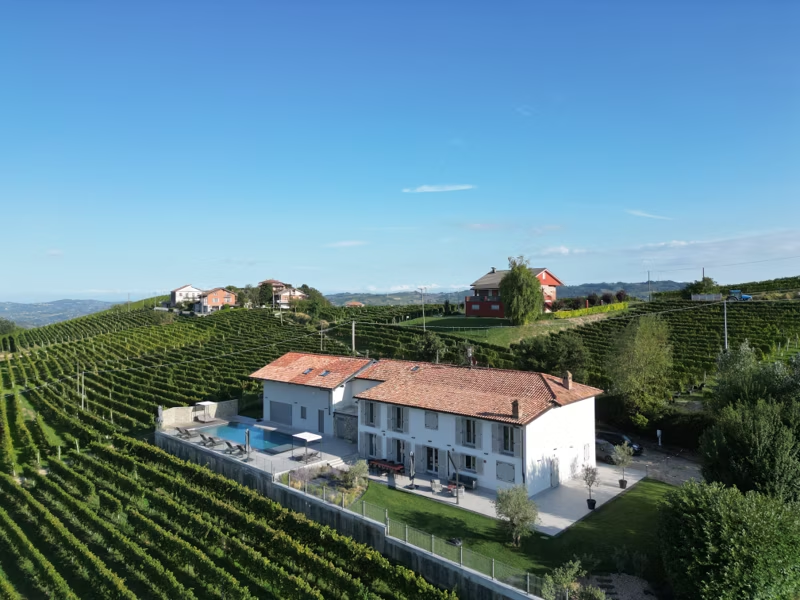
Let me guess. You have a beautiful property in Italy - or you’re thinking about buying one - and someone mentioned you could make good money listing it on Airbnb. So you created an account, took some photos, and then… you went down a rabbit hole of Italian laws, codes, taxes, and registrations that made your head spin.
You’re not alone. Italy has one of the most layered regulatory environments for short-term rentals in Europe, and the rules have changed significantly in the last two years. The good news? None of it is actually that complicated once someone breaks it down clearly.
That’s what this guide is for.
But before we get into the legalities, let’s talk about why Italy is such a strong market for short-term rental hosts right now. Italy ranks in the top five international tourism destinations globally, closing 2024 with 458 million nights spent in tourist accommodations - up 2.5% from the previous year. There are currently between 340,000 and 360,000 active Airbnb listings across the country, with Rome alone accounting for over 45,000. Average hosts in Rome are earning around €38,000 per year. Milan averages €37,000. The demand is real, consistent, and growing.
The opportunity is there. You just need to be set up correctly. Here’s everything you need to know before you welcome your first guest.
First things first: your CIN (and possibly your CIR)
Every short-term rental in Italy now requires a CIN - a Codice Identificativo Nazionale, or National Identification Code. Introduced in September 2024 and fully enforced from January 2025, this is the single most important piece of compliance for any Italian host. Without it, your listing cannot legally appear on Airbnb, Booking.com, or any other platform. Major platforms are legally required to verify your CIN and will block or delist your property if it’s missing.
Depending on your region, you may also still need a CIR (Codice Identificativo Regionale - Regional Identification Code) alongside it. Regions such as Lombardy, Lazio, Sicily, Campania, and Molise explicitly require the CIR for all tourist rentals, and obtaining it is typically a prerequisite before you can apply for the national CIN. Some regions impose time limits too - Lazio, for example, requires you to have your CIR within 60 days of starting your rental activity. Check what applies to your specific region before you list anything.
How to get your CIN - step by step
The CIN application is done entirely online through the Ministry of Tourism’s national database platform, called the BDSR (Banca Dati delle Strutture Ricettive), at bdsr.ministeroturismo.gov.it.
Here’s how the process works:
If you are an Italian resident, you access the platform using your SPID (Sistema Pubblico di Identità Digitale) or your CIE (electronic identity card). If you are a foreign national without Italian residency, you’ll need to register for credentials directly with the Ministry of Tourism as a foreign user - the platform has a dedicated login for this.
Once logged in, your property should automatically appear associated with your Italian tax code (codice fiscale). You then select “Ottieni CIN” (Get CIN), complete the property details form - including address, property type, capacity, and any existing regional codes - and upload the required documentation. This includes proof of ownership, cadastral data, and your safety compliance certificates (more on those below). Once submitted, you receive your CIN by email.
Where you must display your CIN once you have it
Your CIN must appear physically on your property - on or beside the front door, clearly visible from outside. It must also be included in every online listing (Airbnb, Booking.com, your own website), in any social media promotion, and on all advertising materials. Failing to display it correctly carries fines of between €500 and €5,000. Not having one at all can result in fines of up to €8,000 and delisting from all major platforms.
One CIN per property. If you have multiple rentals, each one needs its own code.
Registering your guests with the police - yes, really
This one surprises a lot of new hosts, particularly those coming from countries where nothing like this exists. Within 24 hours of every guest’s arrival, you are legally required to register their personal details - including a copy of their passport or ID - with the state police through an online portal called Alloggiati Web (alloggiatiweb.poliziadistato.it).
This obligation applies to every single stay, every single time, regardless of how long the guest is there for. It applies whether you’re hosting one night or 29 nights. It applies to Italian guests as well as foreign ones.
To use Alloggiati Web, you first need to register with your local Questura (police headquarters) to receive your access credentials. Do this before your first booking, not after. Once you’re set up the process is quick, and there are also property management tools on the market that automate the submission for you - but the legal responsibility always stays with you as the host.
Note that different regions may also have additional tourism reporting systems. Lombardy, for instance, uses a platform called ROSS1000 for monthly statistical reporting, while Friuli-Venezia Giulia uses WEBTUR. This is separate from Alloggiati Web and relates to ISTAT data requirements (covered further below).
How you’ll actually be taxed: Cedolare Secca explained
Italy offers a simplified flat tax regime for short-term rental income called Cedolare Secca - and understanding it properly is essential, because the rules changed at the start of 2026.
Here’s how it works currently:
Your first rental property is taxed at a flat rate of 21% on gross rental income. This replaces IRPEF (standard income tax) and all local surcharges. No deductions are allowed for expenses under this regime, but in exchange you get a simple, predictable, low rate and minimal paperwork. Platforms like Airbnb automatically withhold this 21% at source on qualifying bookings and remit it directly to the Agenzia delle Entrate on your behalf, issuing you an annual Certificazione Unica so you can account for it in your tax return.
If you rent out a second property, the Cedolare Secca rate on that one rises to 26%. You get to choose which property benefits from the lower 21% rate. Both properties can still operate under the Cedolare Secca regime - you’re still a private individual, no Partita IVA required.
The important change from 2026
As of January 1, 2026, if you manage three or more short-term rental properties, you are automatically classified as a business operator. This triggers the mandatory opening of a Partita IVA (Italian VAT number) and a completely different tax framework applies. The old threshold was four properties - it has now been lowered to three. If you are approaching or already at that number, speak to a commercialista (Italian accountant) before you take on that third property. The administrative and tax complexity of operating as a business is considerably greater than operating as a private individual under Cedolare Secca.
Local regulations - where it gets complicated
National law sets the framework. What your specific municipality allows is an entirely different question, and this is where many hosts get caught out.
Italy does not have a single national policy on how many short-term rentals a city can have, how many nights a year a property can be let, or what zones permit short-term rental activity. All of that is decided at regional and municipal level - and the rules vary dramatically.
Venice has some of the strictest short-term rental controls in Italy, including a 120-day threshold rule where renting beyond this limit triggers stricter regulatory treatment. The city actively limits new short-term rental activity in its historic zones.
Florence went even further in May 2025, introducing a full ban on new short-term rental listings within its UNESCO-protected historic centre. If you already had a registered rental in the centro storico before that date, you can continue operating. But if you’re thinking about starting a new listing in central Florence, it’s simply not possible anymore.
Milan requires hosts to file an SCIA (Segnalazione Certificata di Inizio Attività) with the local SUAP (one-stop business desk) before listing. Properties must also have a CIR code registered through the regional ROSS1000 system.
Rome requires municipal registration in addition to the national CIN and charges a tourist tax of €6 per guest per night.
Smaller municipalities are generally more flexible, but the general trend across Italy - following a landmark Constitutional Court ruling in December 2025 that approved Tuscany’s regional restrictions - is toward tighter local control. Emilia-Romagna is already drafting similar regional legislation, and more regions are expected to follow.
Before investing time and money into setting up your listing, always confirm what’s allowed in your specific comune. Call them. Visit the local tourist office. Don’t assume what’s permitted in one Italian city applies to yours.
Safety requirements - what you must have in your property
Safety compliance is non-negotiable for both legal hosting and for obtaining your CIN. Italian law - specifically the legislation introduced in December 2023 - mandates the following for all short-term and tourist rental properties:
Fire extinguishers: At least one portable fire extinguisher per 200 square metres of floor space, and at least one per floor regardless of size. They must have a minimum capacity of 6kg, comply with European standard UNI 9994-1, and be placed in easily accessible, visible locations - ideally near entrances and areas of highest risk. Fines for missing or non-compliant extinguishers range from €600 to €6,000.
Carbon monoxide detectors: Mandatory in any property with combustion appliances - boilers, gas heaters, fireplaces, or any fuel-burning device. Position them 1.5 to 2 metres above floor level, away from windows and doors. They must comply with European standard EN 50291.
Combustible gas detectors: Required where there are gas appliances such as stoves or boilers. Methane detectors must be placed within 30cm of the ceiling (methane is lighter than air); LPG detectors within 30cm of the floor (LPG is heavier than air). Both must be within 1 to 4 metres of the relevant gas appliance, and comply with EN 50194.
Smoke detectors: Required in sleeping areas.
Properties without any gas systems are exempt from the gas detector requirement - but the fire extinguisher obligation applies to all properties without exception.
Make sure emergency exit information is clearly posted inside the property, ideally in both Italian and English, along with local emergency numbers. Insurance is also worth careful attention. Depending on your location and whether you operate under a Partita IVA, civil liability insurance may be legally required - and even where it isn’t, it’s genuinely good practice.
ISTAT registration and tourist flow reporting
You are required to register your rental activity with ISTAT, Italy’s national statistics institute, and submit data on tourist flows - arrivals, overnight stays, guest nationality - on a regular basis. This is mandatory and something many new hosts overlook entirely.
The method varies significantly by region. Most Italian regions have their own dedicated online portal for this. Lombardy uses ROSS1000 (flussituristici.servizirl.it). Friuli-Venezia Giulia uses WEBTUR. Other regions have their own equivalents. If you’re unsure which platform your region uses, contact your local Ufficio del Turismo - they will point you to the right system.
Contract registration with Agenzia delle Entrate
For standard short-term rentals - stays of 30 days or fewer - no contract registration with the Agenzia delle Entrate (agenziaentrate.gov.it) is required. This is one of the genuine administrative advantages of the short-term rental model compared to traditional long-term leases.
However, if any of your rentals exceed 30 consecutive days, you are required to formally register that contract with the tax authority. Registration tax of 2% of the gross rent applies on initial registration and at each annual anniversary. If you’re open to medium or longer stays, factor this in.
Tassa di Soggiorno - tourist tax
Many Italian municipalities require hosts to collect a tourist tax (Tassa di Soggiorno) from guests on a per-person, per-night basis, and remit it to the local council. Rates vary considerably - from as little as €1 to as much as €9.50 per person per night (Milan has temporarily raised its rate to €9.50 for 2026 due to the Winter Olympics, applying to all accommodation within 30km of Olympic venues).
Some cities, including Rome, have Airbnb collect and remit the tourist tax automatically on behalf of hosts. In many other municipalities, hosts are responsible for collecting it directly and paying it to the comune on a periodic basis. Check your local comune website or tourist office for the exact rate and process that applies to you.
A quick compliance checklist before you go live
Before your first guest checks in, make sure you have:
✅Obtained your CIR (if required in your region) and your CIN from the BDSR portal (bdsr.ministeroturismo.gov.it), and displayed the code at the property entrance and in all listings ✅ Registered with your local Questura for Alloggiati Web access (alloggiatiweb.poliziadistato.it) ✅ Installed fire extinguishers, smoke detectors, carbon monoxide detectors, and gas detectors as required ✅ Confirmed your tax situation - whether Cedolare Secca applies and whether Airbnb will withhold on your behalf ✅ Registered with ISTAT through your regional portal ✅Checked your local municipality’s specific rules on tourist tax, zoning, and any additional licences required ✅ Consider whether you need insurance cover for hosting activity
Frequently asked questions: Airbnb hosting in Italy
Is Airbnb legal in Italy in 2026? Yes, Airbnb is completely legal in Italy. However, hosts must comply with national registration requirements (CIN code), tax obligations, guest registration with police via Alloggiati Web, and any additional local rules set by their municipality.
What is the CIN code and do I need one? The CIN (Codice Identificativo Nazionale) is a mandatory national identification code for all short-term rental properties in Italy. You must obtain one via the Ministry of Tourism’s BDSR portal before listing your property on any platform. Without it, Airbnb and Booking.com are legally required to remove your listing.
How much tax do I pay on Airbnb income in Italy? Most private hosts use the Cedolare Secca flat tax regime: 21% on your first rental property and 26% on a second. From three properties onwards, you are classified as a business and must open a Partita IVA.
What is Cedolare Secca? Cedolare Secca is Italy’s simplified flat tax for rental income. It replaces standard IRPEF income tax and all local surcharges. For short-term rentals, the rate is 21% on your first property and 26% on additional ones. Airbnb automatically withholds and remits this on your behalf for qualifying bookings.
How many properties can I rent without opening a Partita IVA? As of January 2026, you can manage up to two short-term rental properties as a private individual. From three properties onwards, Italian law presumes you are operating as a business and a Partita IVA becomes mandatory.
Do I need to register guests with the police? Yes. Within 24 hours of every guest’s arrival, you must submit their identity details to the state police via the Alloggiati Web portal. This applies to every guest, every stay, regardless of nationality or length of stay.
What safety equipment is mandatory in Italian short-term rentals? All properties must have portable fire extinguishers (at least one per 200 sqm and one per floor), smoke detectors in sleeping areas, carbon monoxide detectors near any combustion appliance, and combustible gas detectors where gas appliances are present.
What is the Tassa di Soggiorno? The Tassa di Soggiorno is a tourist tax charged per person per night. Many Italian municipalities require hosts to collect it from guests and remit it to the local council. Rates and rules vary - check with your specific comune.
The bottom line
Italy’s short-term rental market is genuinely exciting. Hosts in Rome average around €38,000 per year. Milan averages €37,000. The tourism demand is strong, the occupancy rates are healthy, and the opportunity to create real income from a property - whether it’s a city apartment, a countryside villa, or a coastal flat - is very real.
But getting the setup right matters more than ever. With increased coordination between platforms, tax authorities, and local police, informal or unregistered rentals in Italy are now a very high-risk strategy. Hosts who launch correctly, with everything in place from day one, can host with confidence. Those who skip steps tend to find out the hard way.
If any of this feels overwhelming - or you just want to make sure you’re doing it right from the start - that’s exactly what I help with at EspressoStays.
👉 Want to start your Italian Airbnb? Book a free call with Espresso Stays HERE - let’s get your rental set up!
Last updated: March 2026. Italian short-term rental regulations change frequently. Always verify requirements with your local tourist office or a qualified commercialista. This guide is for informational purposes only and does not constitute legal or tax advice. Always consult a qualified commercialista for your specific situation.